Showing posts with label Online_Chemistry. Show all posts

CBSE NCERT Class 12 : Organic Chemistry - Haloalkanes and Haloarenes

The replacement of hydrogen atom(s) in a hydrocarbon, aliphatic or aromatic, by halogen atom(s) results in the formation of alkyl halide (haloalkane) and aryl halide (haloarene), respectively. Haloalkanes contain halogen atom(s) attached to the sp3 hybridised carbon atom of an alkyl group whereas haloarenes contain halogen atom(s) attached to sp2 hybridised carbon atom(s) of an aryl group. Many halogen containing organic compounds occur in nature and some of these are clinically useful. These classes of compounds find wide applications in industry as well as in day-to-day life. They are used as solvents for relatively non-polar compounds and as starting materials for the synthesis of wide range of organic compounds. Chlorine containing antibiotic, chloramphenicol, produced by soil microorganisms is very effective for the treatment of typhoid fever. Our body produces iodine containing hormone, thyroxine, the deficiency of which causes a disease called goiter. Synthetic halogen compounds, viz. chloroquine is used for the treatment of malaria; halothane is used as an anaesthetic during surgery. Certain fully fluorinated compounds are being considered as potential blood substitutes in surgery.


1. Classification

Haloalkanes and haloarenes may be classified as follows: 

1.On the Basis of Number of Halogen Atoms 

 These may be classified as mono, di, or polyhalogen (tri-,tetra-, etc.) compounds depending on whether they contain one, two or more halogen atoms in their structures. For example, 
Monohalocompounds may further be classified according to the hybridisation of the carbon atom to which the halogen is bonded, as discussed below. 

2.Compounds Containing sp3 C—X Bond (X= F, Cl, Br, I)
This class includes
(a) Alkyl halides or haloalkanes (R—X)
In alkyl halides, the halogen atom is bonded to an alkyl group (R). They form a homologous series represented by CnH2n+1X. They are further classified as primary, secondary or tertiary according to the nature of carbon to which halogen is attached.


(b) Allylic halides
These are the compounds in which the halogen atom is bonded to an sp3-hybridised carbon atom next to carbon-carbon double bond (C=C) i.e. to an allylic carbon.


 (c) Benzylic halides
These are the compounds in which the halogen atom is bonded to an sp3-hybridised carbon atom next to an aromatic ring.


3.Compounds Containing sp2 C—X Bond 
This class includes:
(a) Vinylic halides
These are the compounds in which the halogen atom is bonded to an sp2-hybridised carbon atom of a carbon-carbon double bond (C = C).

(b) Aryl halides
These are the compounds in which the halogen atom is bonded to the sp2-hybridised carbon atom of an aromatic ring.


2.Nomenclature

Having learnt the classification of halogenated compounds, let us now learn how these are named. The common names of alkyl halides are derived by naming the alkyl group followed by the halide. Alkyl halides are named as halosubstituted hydrocarbons in the IUPAC system of nomenclature. Haloarenes are the common as well as IUPAC names of aryl halides. For dihalogen derivatives, the prefixes o-, m-, p- are used in common system but in IUPAC system, the numerals 1,2; 1,3 and 1,4 are used.


The dihaloalkanes having the same type of halogen atoms are named as alkylidene or alkylene dihalides. The dihalo-compounds having same type of halogen atoms are further classified as geminal halides (halogen atoms are present on the same carbon atom) and vicinal halides (halogen atoms are present on the adjacent carbon atoms). In common name system, gem-dihalides are named as alkylidene halides and vic-dihalides are named as alkylene dihalides. In IUPAC system, they are named as dihaloalkanes.


3.Methods of Preparation

1.From Alcohols

Alkyl halides are best prepared from alcohols, which are easily accessible. The hydroxyl group of an alcohol is replaced by halogen on reaction with concentrated halogen acids, phosphorus halides or thionyl chloride. Thionyl chloride is preferred because the other two products are escapable gases. Hence the reaction gives pure alkyl halides. Phosphorus tribromide and triiodide are usually generated in situ (produced in the reaction mixture) by the reaction of red phosphorus with bromine and iodine respectively. The preparation of alkyl chloride is carried out either by passing dry hydrogen chloride gas through a solution of alcohol or by heating a solution of alcohol in concentrated aqueous acid.
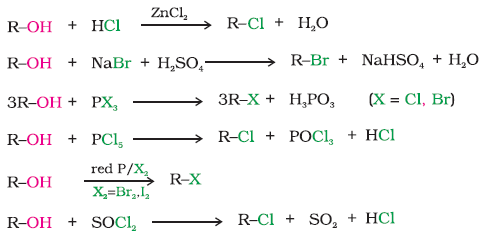
The reactions of primary and secondary alcohols with HX require the presence of a catalyst, ZnCl2. With tertiary alcohols, the reaction is conducted by simply shaking with concentrated HCl at room
temperature. Constant boiling with HBr (48%) is used for preparing alkyl bromide. Good yields of R—I may be obtained by heating alcohols with sodium or potassium iodide in 95% phosphoric acid. The order of reactivity of alcohols with a given haloacid is 3°>2°>1°. The above method is not applicable for the preparation of aryl halides because the carbon-oxygen bond in phenols has a partial double bond character and is difficult to break being stronger than a single bond.

2.From Hydrocarbons
(a) By free radical halogenation
Free radical chlorination or bromination of alkanes gives a complex mixture of isomeric mono- and polyhaloalkanes, which is difficult to separate as pure compounds. Consequently, the yield of any one
compound is low.
b) By electrophilic substitution
Aryl chlorides and bromides can be easily prepared by electrophilic substitution of arenes with chlorine and bromine respectively in the presence of Lewis acid catalysts like iron or iron(III) chloride. 
 
The ortho and para isomers can be easily separated due to large difference in their melting points. Reactions with iodine are reversible in nature and require the presence of an oxidising agent (HNO3,
HIO4) to oxidise the HI formed during iodination. Fluoro compounds are not prepared by this method due to high reactivity of fluorine. 
(c) Sandmeyer’s reaction
When a primary aromatic amine, dissolved or suspended in cold aqueous mineral acid, is treated with sodium nitrite, a diazonium salt is formed. Mixing the solution of freshly prepared diazonium salt with cuprous chloride or cuprous bromide results in the replacement of the diazonium group by –Cl or –Br.
 
Replacement of the diazonium group by iodine does not require the presence of cuprous halide and is done simply by shaking the diazonium salt with potassium iodide.
d) From alkenes
(i) Addition of hydrogen halides: An alkene is converted to corresponding alkyl halide by reaction with hydrogen chloride, hydrogen bromide or hydrogen iodide.
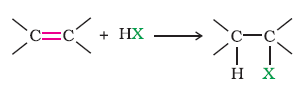
Propene yields two products, however only one predominates as per Markovnikov’s rule.
(ii) Addition of halogens: In the laboratory, addition of bromine in CCl4 to an alkene resulting in discharge of reddish brown colour of bromine constitutes an important method for the detection of
double bond in a molecule. The addition results in the synthesis of vic-dibromides, which are colourless.
3.Halogen Exchange
Alkyl iodides are often prepared by the reaction of alkyl chlorides/ bromides with NaI in dry acetone. This reaction is known as Finkelstein reaction.
NaCl or NaBr thus formed is precipitated in dry acetone. It facilitates the forward reaction according to Le Chatelier’s Principle.
     The synthesis of alkyl fluorides is best accomplished by heating an alkyl chloride/bromide in the presence of a metallic fluoride such as AgF, Hg2F2, CoF2 or SbF3. The reaction is termed as Swarts reaction.


Share:

CBSE NCERT Class 12 : Bonding in Coordination Compounds

Werner was the first to describe the bonding features in coordination compounds. But his theory could not answer basic questions like:
(i) Why only certain elements possess the remarkable property of forming coordination compounds?
(ii) Why the bonds in coordination compounds have directional properties?
(iii) Why coordination compounds have characteristic magnetic and optical properties?
Many approaches have been put forth to explain the nature of bonding in coordination compounds viz. Valence Bond Theory (VBT), Crystal Field Theory (CFT), Ligand Field Theory (LFT) and Molecular Orbital Theory (MOT). We shall focus our attention on elementary treatment of the application of VBT and CFT to coordination compounds.

1.Valence Bond Theory

According to this theory, the metal atom or ion under the influence of ligands can use its (n-1)d, ns, np or ns, np, nd orbitals for hybridisation to yield a set of equivalent orbitals of definite geometry such as octahedral, tetrahedral, square planar. These hybridised orbitals are allowed to overlap with ligand orbitals that can donate electron pairs for bonding. This is illustrated by the following examples.It is usually possible to predict the geometry of a complex from the knowledge of its
magnetic behaviour on the basis of the valence bond theory. In the diamagnetic octahedral complex, [Co(NH3)6]3+, the cobalt ion is in +3 oxidation state and has the electronic configuration 3d6. The hybridisation scheme.Six pairs of electrons, one from each NH3 molecule, occupy the six hybrid orbitals. Thus, the complex has octahedral geometry and is diamagnetic because of the absence of unpaired electron. In the formation of this complex, since the inner d orbital (3d) is used in hybridisation, the complex, [Co(NH3)6]3+ is called an inner orbital or low spin or spin paired complex. The paramagnetic octahedral complex, [CoF6]3– uses outer orbital (4d ) in hybridisation (sp3d2). It is thus called outer orbital or high spin or spin free complex.


In tetrahedral complexes one s and three p orbitals are hybridised to form four equivalent orbitals oriented tetrahedrally. This is illustrated below for [NiCl4]2-. Here nickel is in +2 oxidation state and the ion has the electronic configuration 3d8. Each Cl– ion donates a pair of electrons. The compound is paramagnetic since it contains two unpaired electrons. Similarly, [Ni(CO)4] has tetrahedral geometry but is diamagnetic since nickel is in zero oxidation state and contains no unpaired electron.
In the square planar complexes, the hybridisation involved is dsp2. An example is [Ni(CN)4]2–. Here nickel is in +2 oxidation state and has the electronic configuration 3d8. The hybridisation scheme is as shown in diagram:


Each of the hybridised orbitals receives a pair of electrons from a cyanide ion. The compound is diamagnetic as evident from the absence of unpaired electron.
      It is important to note that the hybrid orbitals do not actually exist. In fact, hybridisation is a mathematical manipulation of wave equation for the atomic orbitals involved.

2.Magnetic Properties of Coordination Compounds

The magnetic moment of coordination compounds can be measured by the magnetic susceptibility experiments. The results can be used to obtain information about the structures adopted by metal complexes. A critical study of the magnetic data of coordination compounds of metals of the first transition series reveals some complications. For metal ions with upto three electrons in the d orbitals, like Ti3+ (d1); V3+ (d2); Cr3+ (d3); two vacant d orbitals are available for octahedral hybridisation with 4s and 4p orbitals. The magnetic behaviour of these free ions and their coordination entities is similar. When more than three 3d electrons are present, the required pair of 3d orbitals for octahedral hybridisation is not directly available (as a consequence of Hund’s rule). Thus, for d4 (Cr2+, Mn3+), d5 (Mn2+, Fe3+), d6 (Fe2+, Co3+) cases, a vacant pair of d orbitals results only by pairing of 3d electrons which leaves two, one and zero unpaired electrons, respectively. The magnetic data agree with maximum spin pairing in many cases, specially with coordination compounds containing d6 ions. However, with species containing d4 and d5 ions there are complications. [Mn(CN)6]3–
has magnetic moment of two unpaired electrons while [MnCl6]3– has a paramagnetic moment of four unpaired electrons. [Fe(CN)6]3– has magnetic moment of a single unpaired electron while [FeF6]3– has a paramagnetic moment of five unpaired electrons. [CoF6]3– is paramagnetic with four
unpaired electrons while [Co(C2O4)3]3– is diamagnetic. This apparent anomaly is explained by valence bond theory in terms of formation of inner orbital and outer orbital coordination entities. [Mn(CN)6]3–, [Fe(CN)6]3– and [Co(C2O4)3]3– are inner orbital complexes involving d2sp3 hybridisation, the former two complexes are paramagnetic and the latter diamagnetic. On the other hand, [MnCl6]3–, [FeF6]3– and [CoF6-]3– are outer orbital complexes involving sp3d2
hybridisation and are paramagnetic corresponding to four, five and four unpaired electrons.

3.Limitations of Valence Bond Theory

While the VB theory, to a larger extent, explains the formation, structures and magnetic behaviour of coordination compounds, it suffers from the following shortcomings:
(i) It involves a number of assumptions.
(ii) It does not give quantitative interpretation of magnetic data.
(iii) It does not explain the colour exhibited by coordination compounds.
(iv) It does not give a quantitative interpretation of the thermodynamic or kinetic stabilities of coordination compounds.
(v) It does not make exact predictions regarding the tetrahedral and square planar structures of 4-coordinate complexes.
(vi) It does not distinguish between weak and strong ligands.

4.Crystal Field Theory

The crystal field theory (CFT) is an electrostatic model which considers the metal-ligand bond to be ionic arising purely from electrostatic interactions between the metal ion and the ligand. Ligands are treated as point charges in case of anions or dipoles in case of neutral molecules. The five d orbitals in an isolated gaseous metal atom/ion have same energy, i.e., they are degenerate. This degeneracy is maintained if a spherically symmetrical field of negative charges surrounds the metal atom/ion. However, when this negative field is due to ligands (either anions or the negative ends of dipolar molecules like NH3 and H2O) in a complex, it becomes asymmetrical and the degeneracy of the d orbitals is lifted. It results in splitting of the d orbitals. The pattern of splitting depends upon the nature of the crystal field. Let us explain this splitting in different crystal fields.
(a) Crystal field splitting in octahedral coordination entities
In an octahedral coordination entity with six ligands surrounding the metal atom/ion, there will be repulsion between the electrons in metal d orbitals and the electrons (or negative charges) of the ligands. Such a repulsion is more when the metal d orbital is directed towards the ligand than when it is away from the ligand. Thus, the 2 2 x −y d and 2 z d orbitals which point towards the axes along the direction of the ligand will experience more repulsion and will be raised in energy; and the dxy, dyz and dxz orbitals which are directed between the axes will be lowered in energy relative to the average energy in the spherical crystal field. Thus, the degeneracy of the d orbitals has been removed due to ligand electron-metal electron repulsions in the octahedral complex to yield three orbitals of lower energy, t2g set and two orbitals of higher energy, eg set. This splitting of the degenerate levels due to the presence of ligands in a definite geometry is termed as crystal field splitting and the energy separation is denoted by Do (the subscript o is for octahedral) . Thus, the energy of the two eg orbitals will increase by (3/5) Do and that of the three t2g will decrease by (2/5)Do. The crystal field splitting, Do, depends upon the field produced by the ligand and charge on the metal ion. Some ligands are able to produce strong fields in which case, the splitting will be large whereas others produce weak fields and consequently result in small splitting of d orbitals. In general, ligands can be arranged in a series in the order of increasing field strength as given below:


Such a series is termed as spectrochemical series. It is an experimentally determined series based on the absorption of light by complexes with different ligands. Let us assign electrons in the d-orbitals of metal ion in octahedral coordination entities. Obviously, the single d electron occupies one of the lower energy t2g orbitals. In d2 and d3 coordination entities, the d electrons occupy the t2g orbitals
singly in accordance with the Hund’s rule. For d4 ions, two possible patterns of electron distribution arise:
(i) the fourth electron could either enter the t2g level and pair with an existing electron, or
(ii) it could avoid paying the price of the pairing energy by occupying the eg level. Which of these possibilities occurs, depends on the relative magnitude of the crystal field splitting, Do and the pairing energy, P (P represents the energy required for electron pairing in a single
orbital). The two options are:
(i) If Do < P, the fourth electron enters one of the eg orbitals giving the configuration 3 1 2g g t e . Ligands for which Do < P are known as weak field ligands and form high spin complexes.
(ii) If Do > P, it becomes more energetically favourable for the fourth electron to occupy a t2g orbital with configuration t2g 4eg0. Ligands which produce this effect are known as strong field ligands and
form low spin complexes. Calculations show that d4 to d7 coordination entities are more stable for strong field as compared to weak field cases.
(b) Crystal field splitting in tetrahedral coordination entities
In tetrahedral coordination entity formation, the d orbital splitting is inverted and is smaller as compared to the octahedral field splitting. For the same metal, the same ligands and metal-ligand distances, it can be shown that Dt = (4/9) D0. Consequently, the orbital splitting energies are not sufficiently large for forcing pairing and, therefore, low spin configurations are rarely observed.

5.Colour in Coordination Compounds

In the previous Unit, we learnt that one of the most distinctive properties of transition metal complexes is their wide range of colours. This means that some of the visible spectrum is being removed from white light as it passes through the sample, so the light that emerges is no longer white. The colour of the complex is complementary to that which is absorbed. The complementary colour is the colour generated from the wavelength left over; if green light is absorbed by the complex, it appears red. Table 9.3 gives the relationship of the The colour in the coordination compounds can be readily explained in terms of the crystal field theory. Consider, for example, the complex [Ti(H2O)6]3+, which is violet in colour. This is an octahedral complex where the single electron (Ti3+ is a 3d1 system) in the metal d orbital is in the t2g level in the ground state of the complex. The next higher state available for the electron is the empty eg level. If light corresponding to the energy of blue-green region is absorbed by the complex, it would excite the electron from t2g level to the eg level (t2g 1eg 0 -> t2g 0eg1). Consequently, the complex appears violet in colour. The
crystal field theory attributes the colour of the coordination compounds to d-d transition of the electron.different wavelength absorbed and the colour observed.

6.Limitations of Crystal Field Theory

The crystal field model is successful in explaining the formation, structures, colour and magnetic properties of coordination compounds to a large extent. However, from the assumptions that the ligands are point charges, it follows that anionic ligands should exert the greatest splitting effect. The anionic ligands actually are found at the low end of the spectrochemical series. Further, it does not take into account the covalent character of bonding between the ligand and the central atom. These are some of the weaknesses of CFT, which are explained by ligand field theory (LFT) and molecular orbital theory which are beyond the scope of the present study.

Share:

CBSE NCERT Class 12 : Isomerism in Coordination Compounds

Isomers are two or more compounds that have the same chemical formula but a different arrangement of atoms. Because of the different arrangement of atoms, they differ in one or more physical or chemical properties. Two principal types of isomerism are known among coordination compounds. Each of which can be further subdivided.
(a) Stereoisomerism
(i) Geometrical isomerism (ii) Optical isomerism
(b) Structural isomerism
(i) Linkage isomerism (ii) Coordination isomerism
(iii) Ionisation isomerism (iv) Solvate isomerism
Stereoisomers have the same chemical formula and chemical bonds but they have different spatial arrangement. Structural isomers have different bonds. A detailed account of these isomers are given below.

1.Geometric Isomerism

    This type of isomerism arises in heteroleptic complexes due to different possible geometric arrangements of the ligands. Important examples of this behaviour are found with coordination numbers 4 and 6. In a square planar complex of formula [MX2L2] (X and L are unidentate), the two ligands X may be arranged adjacent to each other in a cis-isomer, or opposite to each other in a trans-isomer.
     Other square planar complex of the type MABXL (where A, B, X, L are unidentates) shows three isomers-two cis and one trans. You may attempt to draw these structures. Such isomerism is not possible for a tetrahedral geometry but similar behaviour is possible in octahedral complexes of formula [MX2L4] in which the two ligands X may be oriented cis or trans to each other.
This type of isomerism also arises when didentate ligands L – L [e.g., NH2 CH2 CH2 NH2 (en)] are present in complexes of formula [MX2(L–L)2]. Another type of geometrical isomerism occurs in octahedral coordination entities of the type [Ma3b3] like [Co(NH3)3(NO2)3]. If three donor atoms of the same ligands occupy adjacent positions at the corners of an octahedral face, we have the facial (fac) isomer. When the positions are around the meridian of the octahedron, we get the meridional
(mer) isomer.

2. Optical Isomerism

Optical isomers are mirror images that cannot be superimposed on one another. These are called as
enantiomers. The molecules or ions that cannot be superimposed are called chiral. The two forms are called dextro (d) and laevo (l) depending upon the direction they rotate the plane of polarised light in a polarimeter (d rotates to the right, l to the left). Optical isomerism is common in octahedral complexes involving didentate ligands. In a coordination entity of the type [PtCl2(en)2]2+, only the cis-isomer shows optical activity.

3.Linkage Isomerism

Linkage isomerism arises in a coordination compound containing ambidentate ligand. A simple example is provided by complexes containing the thiocyanate ligand, NCS–, which may bind through the nitrogen to give M–NCS or through sulphur to give M–SCN. Jørgensen discovered such behaviour in the complex [Co(NH3)5(NO2)]Cl2, which is obtained as the red form, in which the nitrite ligand is bound through oxygen (–ONO), and as the yellow form, in which the nitrite ligand is
bound through nitrogen (–NO2).

4.Coordination Isomerism

This type of isomerism arises from the interchange of ligands between cationic and anionic entities of different metal ions present in a complex. An example is provided by [Co(NH3)6][Cr(CN)6], in which the NH3 ligands are bound to Co3+ and the CN– ligands to Cr3+. In its coordination isomer [Cr(NH3)6][Co(CN)6], the NH3 ligands are bound to Cr3+ and the CN– ligands to Co3+.

5.Ionisation Isomerism

This form of isomerism arises when the counter ion in a complex salt is itself a potential ligand and can displace a ligand which can then become the counter ion. An example is provided by the ionisation isomers [Co(NH3)5SO4]Br and [Co(NH3)5Br]SO4.

6.Solvate Isomerism

This form of isomerism is known as ‘hydrate isomerism’ in case where water is involved as a solvent. This is similar to ionisation isomerism. Solvate isomers differ by whether or not a solvent molecule is directly bonded to the metal ion or merely present as free solvent molecules in the crystal lattice. An example is provided by the aqua complex [Cr(H2O)6]Cl3 (violet) and its solvate isomer [Cr(H2O)5Cl]Cl2.H2O (grey-green).


Share:

CBSE NCERT Class 12 : Nomencleture of coordinate compounds

Nomenclature is important in Coordination Chemistry because of the need to have an unambiguous method of describing formulas and writing systematic names, particularly when dealing with isomers. The formulas and names adopted for coordination entities are based on the recommendations of the International Union of Pure and Applied chemistry (IUPAC).


Formulas of Mononuclear Coordination Entities

The formula of a compound is a shorthand tool used to provide basic information about the constitution of the compound in a concise and convenient manner. Mononuclear coordination entities contain a single central metal atom. The following rules are applied while writing the formulas:
(i) The central atom is listed first.
(ii) The ligands are then listed in alphabetical order. The placement of a ligand in the list does not depend on its charge.
(iii) Polydentate ligands are also listed alphabetically. In case of abbreviated ligand, the first letter of the abbreviation is used to determine the position of the ligand in the alphabetical order.
(iv) The formula for the entire coordination entity, whether charged or not, is enclosed in square brackets. When ligands are polyatomic, their formulas are enclosed in parentheses. Ligand abbreviations are also enclosed in parentheses.
(v) There should be no space between the ligands and the metal within a coordination sphere.
(vi) When the formula of a charged coordination entity is to be written without that of the counter ion, the charge is indicated outside the square brackets as a right superscript with the number before the sign. For example, [Co(CN)6]3–, [Cr(H2O)6]3+, etc.
(vii) The charge of the cation(s) is balanced by the charge of the anion(s).


Naming of Mononuclear Coordination Compounds

The names of coordination compounds are derived by following the principles of additive nomenclature. Thus, the groups that surround the central atom must be identified in the name. They are listed as prefixes to the name of the central atom along with any appropriate multipliers. The following rules are used when naming coordination compounds:
(i) The cation is named first in both positively and negatively charged coordination entities.
(ii) The ligands are named in an alphabetical order before the name of the central atom/ion. (This procedure is reversed from writing formula).
(iii) Names of the anionic ligands end in –o, those of neutral and cationic ligands are the same except aqua for H2O, ammine for NH3, carbonyl for CO and nitrosyl for NO. These are placed within
enclosing marks ( ).
(iv) Prefixes mono, di, tri, etc., are used to indicate the number of the individual ligands in the coordination entity. When the names of the ligands include a numerical prefix, then the terms, bis, tris, tetrakis are used, the ligand to which they refer being placed in parentheses. For example, [NiCl2(PPh3)2] is named as dichlorobis(triphenylphosphine)nickel(II).
(v) Oxidation state of the metal in cation, anion or neutral coordination entity is indicated by Roman numeral in parenthesis.
(vi) If the complex ion is a cation, the metal is named same as the element. For example, Co in a complex cation is called cobalt and Pt is called platinum. If the complex ion is an anion, the name of
the metal ends with the suffix – ate. For example, Co in a complex anion, ( ) 2 4 Co SCN− is called cobaltate. For some metals, the Latin names are used in the complex anions, e.g., ferrate for Fe.
(vii) The neutral complex molecule is named similar to that of the complex cation.
The following examples illustrate the nomenclature for coordination compounds.
1. [Cr(NH3)3(H2O)3]Cl3 is named as: triamminetriaquachromium(III) chloride
Explanation: The complex ion is inside the square bracket, which is a cation. The amine ligands are named before the aqua ligands according to alphabetical order. Since there are three chloride ions in
the compound, the charge on the complex ion must be +3 (since the compound is electrically neutral). From the charge on the complex ion and the charge on the ligands, we can calculate the oxidation
number of the metal. In this example, all the ligands are neutral molecules. Therefore, the oxidation number of chromium must be the same as the charge of the complex ion, +3.
2. [Co(H2NCH2CH2NH2)3]2(SO4)3 is named as: tris(ethane-1,2–diammine)cobalt(III) sulphate
Explanation: The sulphate is the counter anion in this molecule. Since it takes 3 sulphates to bond with two complex cations, the charge on each complex cation must be +3. Further, ethane-1,2–
diamine is a neutral molecule, so the oxidation number of cobalt in the complex ion must be +3. Remember that you never have to indicate the number of cations and anions in the name of an ionic compound.
3. [Ag(NH3)2][Ag(CN)2] is named as: diamminesilver(I) dicyanoargentate(I)

Share:

CBSE Class 12 NCERT : Coordination Compounds

In modern terminology such compounds are called coordination compounds. The chemistry of coordination compounds is an important and challenging area of modern inorganic chemistry. New concepts of chemical bonding and molecular structure have provided insights into the functioning of
vital components of biological systems. Chlorophyll, hemoglobin and vitamin B12 are coordination
compounds of magnesium, iron and cobalt respectively. Variety of metallurgical processes, industrial catalysts and analytical reagents involve the use of coordination compounds. Coordination compounds also find many applications in electroplating, textile dyeing and medicinal chemistry.

Werner’s Theory of Coordination Compounds

Alfred Werner (1866-1919), a Swiss chemist was the first to formulate his ideas about the structures of coordination compounds. He prepared and characterised a large number of coordination compounds and studied their physical and chemical behaviour by simple experimental techniques. Werner proposed the concept of a primary valence and a secondary valence for a metal ion. Binary compounds such as CrCl3, CoCl2 or PdCl2 have primary valence of 3, 2 and 2 respectively. In a series of compounds of cobalt(III) chloride with ammonia, it was found that some of the chloride ions could be precipitated as AgCl on adding excess silver nitrate solution in cold but some remained in solution.
These observations, together with the results of conductivity measurements in solution can be explained if (i) six groups in all, either chloride ions or ammonia molecules or both, remain bonded to
the cobalt ion during the reaction and (ii) the compounds are formulated, where the atoms within the square brackets form a single entity which does not dissociate under the reaction conditions. Werner proposed the term secondary valence for the number of groups bound directly to the metal ion; in each of these examples the secondary valences are six.
Note that the last two compounds have identical empirical formula, CoCl3.4NH3, but distinct properties. Such compounds are termed as isomers. Werner in 1898, propounded his theory of
coordination compounds. The main postulates are:
1. In coordination compounds metals show two types of linkages (valences)-primary and secondary.
2. The primary valences are normally ionisable and are satisfied by negative ions.
3. The secondary valences are non ionisable. These are satisfied by neutral molecules or negative ions. The secondary valence is equal to the coordination number and is fixed for a metal.
4. The ions/groups bound by the secondary linkages to the metal have characteristic spatial arrangements corresponding to different coordination numbers.
In modern formulations, such spatial arrangements are called coordination polyhedra. The species within the square bracket are coordination entities or complexes and the ions outside the square bracket are called counter ions.
He further postulated that octahedral, tetrahedral and square planar geometrical shapes are more common in coordination compounds of transition metals. Thus, [Co(NH3)6]3+, [CoCl(NH3)5]2+ and [CoCl2(NH3)4]+ are octahedral entities, while [Ni(CO)4] and [PtCl4]2– are tetrahedral and
square planar, respectively.


Difference between a double salt and a complex
Both double salts as well as complexes are formed by the combination of two or more stable compounds in stoichiometric ratio. However, they differ in the fact that double salts such as carnallite , KCl.MgCl2.6H2O, Mohr’s salt, FeSO4.(NH4)2SO4.6H2O, potash alum, KAl(SO4)2.12H2O, etc. dissociate into simple ions completely when dissolved in water. However, complex ions such as [Fe(CN)6]4– of K4Fe(CN)6, do not dissociate into Fe2+ and CN– ions.

Definitions of Some Important Terms Pertaining to Coordination Compounds

(a) Coordination entity:A coordination entity constitutes a central metal atom or ion bonded to a fixed number of ions or molecules. For example, [CoCl3(NH3)3] is a coordination entity in which the cobalt ion is surrounded by three ammonia molecules and three chloride ions. Other examples are [Ni(CO)4], [PtCl2(NH3)2], [Fe(CN)6]4–, [Co(NH3)6]3+.
(b) Central atom/ion:In a coordination entity, the atom/ion to which a fixed number of ions/groups are bound in a definite geometrical arrangement around it, is called the central atom or ion. For example, the central atom/ion in the coordination entities: [NiCl2(H2O)4], [CoCl(NH3)5]2+ and [Fe(CN)6]3– are Ni2+, Co3+ and Fe3+, respectively. These central atoms/ions are also referred to as Lewis acids.
(c) Ligands:The ions or molecules bound to the central atom/ion in the coordination entity are called ligands. These may be simple ions such as Cl–, small molecules such as H2O or NH3, larger molecules such as H2NCH2CH2NH2 or N(CH2CH2NH2)3 or even macromolecules, such as proteins.
When a ligand is bound to a metal ion through a single donor atom, as with Cl–, H2O or NH3, the ligand is said to be unidentate. When a ligand can bind through two donor atoms as in H2NCH2CH2NH2 (ethane-1,2-diamine) or C2O4 2– (oxalate), the ligand is said to be didentate and when several donor atoms are present in a single ligand as in N(CH2CH2NH2)3, the ligand is said to be polydentate. Ethylenediaminetetraacetate ion (EDTA4–) is an important hexadentate ligand. It can bind through two nitrogen and four oxygen atoms to a central metal ion.
 When a di- or polydentate ligand uses its two or more donor atoms to bind a single metal ion, it is said to be a chelate ligand. The number of such ligating groups is called the denticity of the ligand. Such complexes, called chelate complexes tend to be more stable than similar complexes containing unidentate ligands . Ligand which can ligate through two different atoms is called ambidentate ligand. Examples of such ligands are the NO2– and SCN– ions. NO2– ion can coordinate either through nitrogen or through oxygen to a central metal atom/ion. Similarly, SCN– ion can coordinate through the sulphur or nitrogen atom.
(d) Coordination number:The coordination number (CN) of a metal ion in a complex can be defined as the number of ligand donor atoms to which the metal is directly bonded. For example, in the complex ions, [PtCl6]2– and [Ni(NH3)4]2+, the coordination number of Pt and Ni are 6 and 4 respectively. Similarly, in the complex ions, [Fe(C2O4)3]3– and [Co(en)3]3+, the coordination number of both, Fe and Co, is 6 because C2O4 2– and en (ethane-1,2-diamine) are didentate ligands. It is important to note here that coordination number of the central atom/ion is determined only by the number of sigma bonds formed by the ligand with the central atom/ion. Pi bonds, if formed between the ligand and the central atom/ion, are not counted for this purpose.
e) Coordination sphere:The central atom/ion and the ligands attached to it are enclosed in square bracket and is collectively termed as the coordination sphere. The ionisable groups are written outside the bracket and are called counter ions. For example, in the complex K4[Fe(CN)6], the coordination sphere is [Fe(CN)6]4– and the counter ion is K+.
(f) Coordination polyhedron:The spatial arrangement of the ligand atoms which are directly attached to the central atom/ion defines a coordination polyhedron about the central atom. The most common
coordination polyhedra are octahedral, square planar and tetrahedral. For example, [Co(NH3)6]3+ is octahedral, [Ni(CO)4] is tetrahedral and [PtCl4]2– is square planar. Figures under shows the
shapes of different coordination polyhedra.


(g) Oxidation number of central atom:The oxidation number of the central atom in a complex is defined as the charge it would carry if all the ligands are removed along with the electron pairs that are shared with the central atom. The oxidation number is represented by a Roman numeral in parenthesis following the name of the coordination entity. For example, oxidation number of copper in [Cu(CN)4]3– is +1 and it is written as Cu(I).
(h) Homoleptic and heteroleptic complexes:Complexes in which a metal is bound to only one kind of donor groups, e.g., [Co(NH3)6]3+, are known as homoleptic. Complexes in which a metal is bound to more than one kind of donor groups, e.g., [Co(NH3)4Cl2]+, are known as heteroleptic.

Share:

CBSE Class 12: D and F block elements

The d-block of the periodic table contains the elements of the groups 3-12 in which the d orbitals are
progressively filled in each of the four long periods. The elements constituting the f -block are those in which the 4 f and 5 f orbitals are progressively filled in the latter two long periods; these elements are formal members of group 3 from which they have been taken out to form a separate f-block of the periodic table. The names transition metals and inner transition metals are often used to refer to the elements of d-and f-blocks respectively.
     There are mainly three series of the transition metals, 3d series (Sc to Zn), 4d series (Y to Cd) and 5d series (La to Hg, omitting Ce to Lu). The fourth 6d series which begins with Ac is still incomplete. The two series of the inner transition metals, (4f and 5f) are known as lanthanoids and actinoids respectively. Strictly speaking, a transition element is defined as the one which has incompletely filled d orbitals in its ground state or in any one of its oxidation states. Zinc, cadmium and mercury of group 12 have full d10 configuration in their ground state as well as in their common oxidation states and hence, are not regarded as transition metals. However, being the end members of the three transition series, their chemistry is studied along with the chemistry of the transition metals.
    The presence of partly filled d or f orbitals in their atoms sets the study of the transition elements and their compounds apart from that of the main group elements. However, the usual theory of valence as applicable to the main group elements can also be applied successfully to the transition elements. Various precious metals such as silver, gold and platinum and industrially important metals like iron, copper and titanium form part of the transition metals. In this Unit, besides introduction, we shall first deal with the electronic configuration, occurrence and general characteristics of the transition elements with special emphasis on the trends in the properties of the first row (3d) transition metals and the preparation and properties of some important compounds. This will be
followed by consideration of certain general aspects such as electronic configurations, oxidation states and chemical reactivity of the inner transition metals.

THE TRANSITION ELEMENTS (d-BLOCK)

Position in the Periodic Table

The d–block occupies the large middle section flanked by s– and p– blocks in the periodic table. The very name ‘transition’ given to the elements of d-block is only because of their position between s– and p– block elements. The d–orbitals of the penultimate energy level in their atoms receive electrons giving rise to the three rows of the transition metals, i.e., 3d, 4d and 5d. The fourth row of 6d is still incomplete.

Electronic Configurations of the d-Block Elements

In general the electronic configuration of these elements is (n-1)d1–10ns1–2. The (n–1) stands for the inner d orbitals which may have one to ten electrons and the outermost ns orbital may have one or two electrons. However, this generalisation has several exceptions because of very little energy difference between (n-1)d and ns orbitals. Furthermore, half and completely filled sets of orbitals are relatively more stable. A consequence of this factor is reflected in the electronic configurations of Cr and Cu in the 3d series. Consider the case of Cr, for example, which has 3d5 4s1 instead of 3d44s2; the energy gap between the two sets (3d and 4s) of orbitals is small enough to prevent electron entering the 3d orbitals. Similarly in case of Cu, the configuration is 3d104s1 and not 3d94s2.

The electronic configurations of Zn, Cd and Hg are represented by the general formula (n-1)d10ns2. The orbitals in these elements are completely filled in the ground state as well as in their common
oxidation states. Therefore, they are not regarded as transition elements. The d orbitals of the transition elements project to the periphery of an atom more than the other orbitals (i.e., s and p), hence, they are more influenced by the surroundings as well as affecting the atoms or molecules
surrounding them. In some respects, ions of a given dn configuration (n = 1 – 9) have similar magnetic and electronic properties. With partly filled d orbitals these elements exhibit certain characteristic properties such as display of a variety of oxidation states, formation of coloured ions and entering into complex formation with a variety of ligands. The transition metals and their compounds also exhibit catalytic property and paramagnetic behaviour. All these characteristics have
been discussed in detail later in this Unit. There are greater horizontal similarities in the properties of the transition elements in contrast to the main group elements. However, some group similarities also exist. We shall first study the general characteristics and their trends in the horizontal rows (particularly 3d row) and then consider some group similarities.

General Properties of the Transition Elements (d-Block) 

1.Physical Properties

Nearly all the transition elements display typical metallic properties such as high tensile strength, ductility, malleability, high thermal and electrical conductivity and metallic lustre. With the exceptions of Zn, Cd, Hg and Mn, they have one or more typical metallic structures at normal temperatures. The transition metals (with the exception of Zn, Cd and Hg) are very much hard and
have low volatility. Their melting and boiling points are high. The high melting points of these metals are attributed to the involvement of greater number of electrons from (n-1)d in addition to the ns electrons in the interatomic metallic bonding. In any row the melting points of these metals rise to a maximum at d5 except for anomalous values of Mn and Tc and fall regularly as the atomic number increases. They have high enthalpies of atomisation. The maxima at about the middle of each series indicate that one unpaired electron per d orbital is particularly favourable for strong interatomic interaction. In general, greater the number of valence electrons, stronger is the resultant bonding. Since the enthalpy of atomisation is an important factor in determining the standard electrode potential of a metal, metals with very high enthalpy of atomisation (i.e., very high boiling point) tend to be noble in their reactions (see later for electrode potentials). Another generalisation that may be drawn is that the metals of the second and third series have greater enthalpies of atomisation than the corresponding elements of the first series; this is an important factor in accounting for the occurrence of much more frequent metal – metal bonding in compounds of the heavy transition metals.
2. Variation in Atomic and Ionic Sizes of Transition Metals
In general, ions of the same charge in a given series show progressive decrease in radius with increasing atomic number. This is because the new electron enters a d orbital each time the nuclear charge increases by unity. It may be recalled that the shielding effect of a d electron is not that effective, hence the net electrostatic attraction between the nuclear charge and the outermost electron increases and the ionic radius decreases. The same trend is observed in the atomic radii of a given series. However, the variation within a series is quite small. An interesting point emerges when atomic sizes of one series are compared with those of the corresponding elements in the other series. The curves show an increase from the first (3d) to the second (4d) series of the elements but the radii of the third (5d) series are virtually the same as those of the corresponding members of the second series. This phenomenon is associated with the intervention of the 4f orbitals which must be filled before the 5d series of elements begin. The filling of 4f before 5d orbital results in a regular decrease in atomic radii called Lanthanoid contraction which essentially compensates for the expected increase in atomic size with increasing atomic number. The net result of the lanthanoid contraction is that the second and the third d series exhibit similar radii (e.g., Zr 160 pm, Hf 159 pm) and have very similar
physical and chemical properties much more than that expected on the basis of usual family relationship.


Share: